


Stone Faces Against Evil: the Apotropaic Masks of Turi


In Turi, carved into stone and entrusted to time, around thirty apotropaic masks still survive today. They are not numerous and they do not include animal figures or zoomorphic faces: they are exclusively human faces, placed at the most sensitive and symbolic points of daily life. They can be found on the keystones of arches, on door knockers, on fan-shaped lunettes, and on rings once used to tie livestock. They stand on thresholds, guarding the boundary between inside and outside, between safety and threat.

These masks belong to a vast repertoire of symbols, objects and amulets which, since antiquity, have formed a protective shield against hostile spirits in popular belief. At their core lay a deeply rooted conviction, fuelled by fear and imagination: the existence of invisible beings capable of influencing the natural course of life, for better or for worse.
Among the most widespread superstitions was that of the evil eye, understood as the power to transmit negative influences through the strength of one’s gaze. Against this subtle and dangerous force, people sought protection through symbols. Apotropaic masks served precisely this purpose: not as decoration, but as instruments of defence, meant to repel evil and send the curse back to its source.
Turi preserves particularly distinctive examples of these masks. The faces are often frightening, marked by magnetic stares and exaggerated features: gaping mouths, grotesque distortions, mocking or caricatured expressions. According to popular belief, it was precisely this deformation that made them effective, frightening evil before it could act.
Among the most interesting examples are unusual pairs of portraits, interpreted as representations of the homeowner and his wife; a shop sign belonging to a blacksmith dated 1922; heads of young women with long hair carved above doors and windows; male faces with burlesque expressions; and the heads of small lions with human features. These last examples represent the only visual trace of what was once known as the “gùra”: the frightening head, intended above all to scare children.
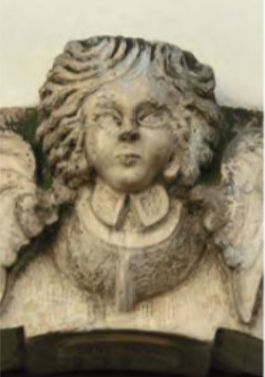
There are also angelic variants decorating the chapels of the municipal cemetery, showing how the apotropaic function could take on more reassuring forms, while remaining protective. Here too, sculpture is not mere ornament: it is guardianship, protection of both place and soul.
Most of these masks in Turi date to the 1910s and 1920s. None bears the signature of its maker, yet stylistic similarities suggest that many may be the work of the same master craftsman.
Today, unfortunately, only a small number of these masks are in relatively good condition. Most are affected by deterioration which, over time, threatens the very survival of these small but precious historical testimonies. With them, there is a risk of losing not only an artistic heritage, but also an intimate part of the town’s collective imagination.
The apotropaic masks of Turi are not merely stone faces. They are silent stories of fear and protection, of beliefs passed down through generations, of an enduring dialogue between the visible and the invisible. Even now, motionless on thresholds, they continue to perform their ancient task: keeping watch.
Sources and credits
Original article: Pamela Luisi, Maschere apotropaiche. Uno scudo contro gli spiriti avversi
Photographs: Apotropaic masks of Turi (arches, doorways, Municipal Cemetery)


Comments