


Between Light and Sacrifice: the Nativity and the Crucifixion by Samuele Tatulli in the Church of the Clarisses of Turi
- TuriBorgoAntico

- Jan 2
- 3 min read
There is a special silence that inhabits the Church of the Clarisses of Turi. It is a silence made of light and shadow, of birth and death, of waiting and fulfilment. On either side of the single nave, like two pages of the same sacred narrative, stand facing each other the Nativity with Saint Mark and the Crucifixion, two canvases attributed to the sensitive and restless brush of Samuele Tatulli (1754 – documented 1826), a Puglian painter whose figure is slowly emerging from the past thanks to the patient work of art historians.
As Giovanni Boraccesi wrote in 1994, Tatulli is one of those artistic personalities “whose lives, although still obscure, are becoming ever more clearly defined through the continuous contributions of critical scholarship”. It was Boraccesi himself who, through studies published in the journal Fogli di periferia and thanks to a precise archival reference — the Notamento of the mayor Lomastro dated 1811 — first attributed to the painter from Palo del Colle (and not from Conversano, as is often erroneously reported) the two canvases now preserved in Turi.
Tatulli, a prolific and itinerant artist, left traces of his work in numerous centres across Puglia and Basilicata — from Ferrandina to Bari, from Rutigliano to Oria — covering a creative span from 1781 to 1826. In Turi, in addition to the two works for the Clarisses, he also produced other paintings that are now lost, once housed in the chapels of Saint Joseph and Saint Orontius, bearing witness to an intense yet fragmentary artistic presence.

In the Crucifixion, the scene of Golgotha is imbued with a composed yet harrowing sorrow. The body of Christ, suspended and utterly exhausted, inclines the cross as if reaching towards His Mother, who occupies the left side of the canvas. Between them unfolds a silent dialogue of broken gestures and searching gazes. Mary Magdalene, kneeling, clutches her hair as a final anchor against despair, while John, in the shadows, clasps his hands in restrained anguish. In the background, a storm-laden sky is faintly illuminated by a group of angels, a fragile promise of redemption.
Tatulli orchestrates the composition through bold chromatic contrasts: the blue of Mary’s mantle, the yellow and white of Magdalene, the red and green of John. Everything revolves around the wounded body of Christ, the true emotional fulcrum of the scene, heightened by the white drapery that draws the eye and leads it to the very heart of the tragedy.
The canvas still bears the scars of the collapse of March 1949, when the church vault gave way, irreversibly damaging many artworks. The restoration promoted by the then Superintendent Schettini restored dignity and legibility to the painting, without entirely erasing its wounds, which today stand as visible memories of time and fragility.
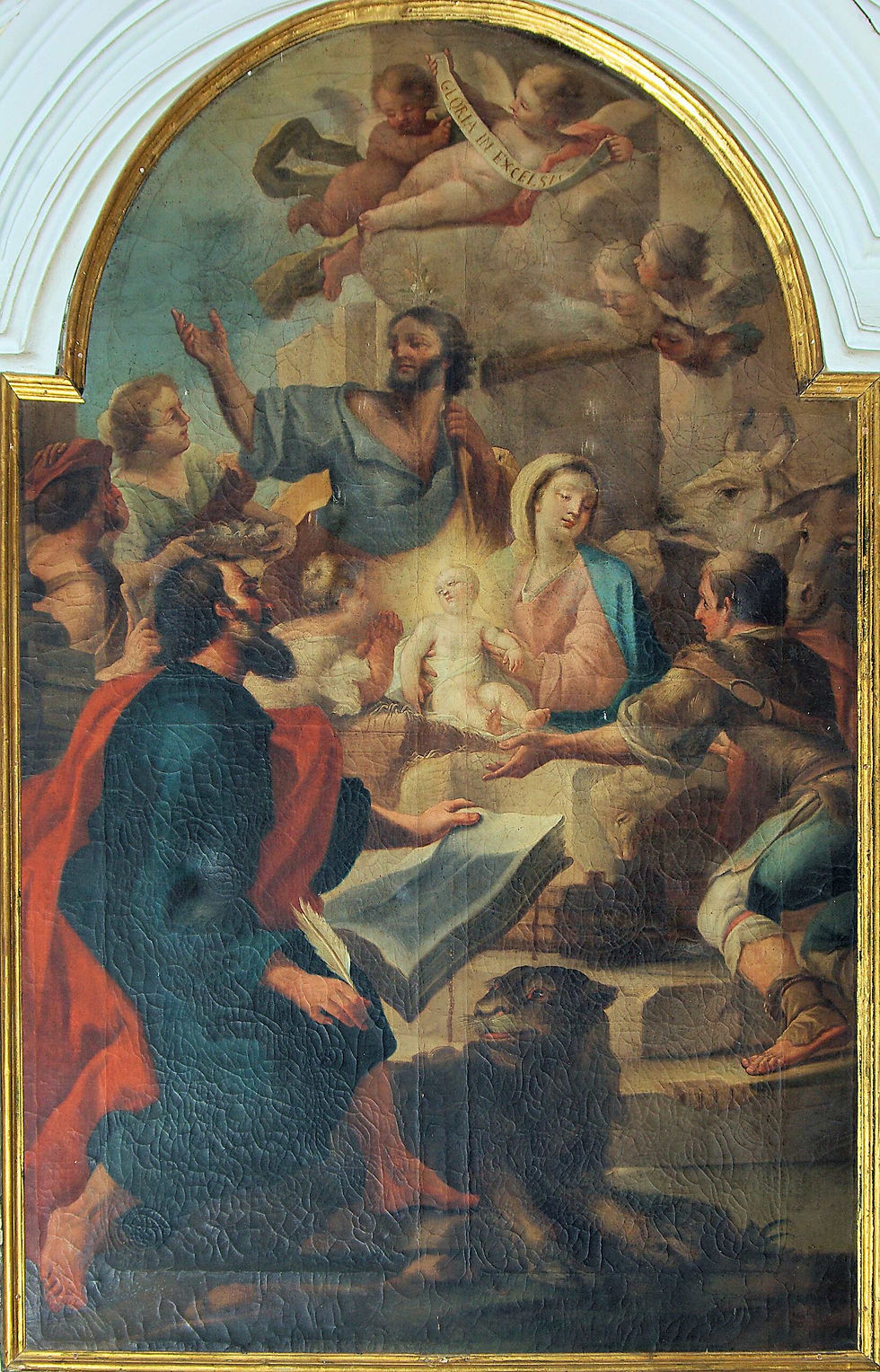
Opposite, the Nativity with Saint Mark tells the beginning. Here the light is gentler, yet no less intense. The Holy Family is set back, almost gathered in intimacy, while in the foreground rises the imposing figure of the Evangelist Mark, wrapped in a greenish tunic and accompanied by the lion, his iconographic attribute. A silent witness, he records with a white quill the “good news” of a God made man.
The presence of Saint Mark in the Nativity scene both surprises and invites reflection: his Gospel is, in fact, the only one not to recount the birth of Jesus. Perhaps a theological forcing, linked to the wishes of the patrons or to a particular local devotion, which Tatulli embraces and transforms into a powerful visual symbol.
The Child is the vital centre of the composition: Mary supports Him and points Him out with her gaze, Joseph converses with the visitors, shepherds adore, angels hover above, and everything seems to move in a harmonious vortex whose energy flows from the newborn who has come into the world to redeem humanity. A circular dynamism, enhanced by drapery, vivid colours and interwoven gazes, that renders the scene alive, pulsating and profoundly human.
Thus, within the Church of the Clarisses, Tatulli narrates the entire arc of Christ’s existence: from the light of birth to the shadow of the cross. Two canvases that are not merely works of art, but pages of a visual meditation, still capable today of speaking to the heart of anyone who pauses to listen.
Sources and credits
Text reworked from: original article by Giovanni Lerede, published on 09/03/2023, Culture section.
Critical references: Giovanni Boraccesi, studies on Samuele Tatulli, Fogli di periferia, 1994.
Photographic credits: photographs by Giovanni Palmisano.


Comments