


Turi, the city rising from the earth

Peuceti, tombs, walls and memories: an invisible archaeological heritage

There is a side of Turi that does not immediately reveal itself to the eye, yet continues to rise from beneath the ground, returning fragments of a very ancient history. It is the Turi of the Peuceti, of necropolises, medieval walls, prehistoric settlements and archaeological discoveries that have emerged over more than a century, often by chance, during urban works or occasional excavations. A stratified and complex city, one that tells the story of a remarkable past and which, even today, struggles to achieve full recognition and valorisation.
As Giovanni Lerede writes in the il paese supplement, the archaeological history of Turi is a story of patience, waiting and interruptions, of important discoveries followed by long periods of silence. It is no coincidence that the expression “the patience of the Peuceti” becomes an effective interpretative key for understanding the fate of a heritage that continues to resurface without ever being fully embraced as a shared resource.
The earliest traces of human settlement in the territory of Turi date back to prehistory. In 2003, in the Lamarossa area, lithic tools made of hard stone and sandstone were discovered and attributed to an Eneolithic hut village. These finds, studied by the Archaeological Superintendency and published in the journal Sulletracce of the Centro Studi di Storia e Cultura di Turi, testify to a stable occupation of the area from very remote times.
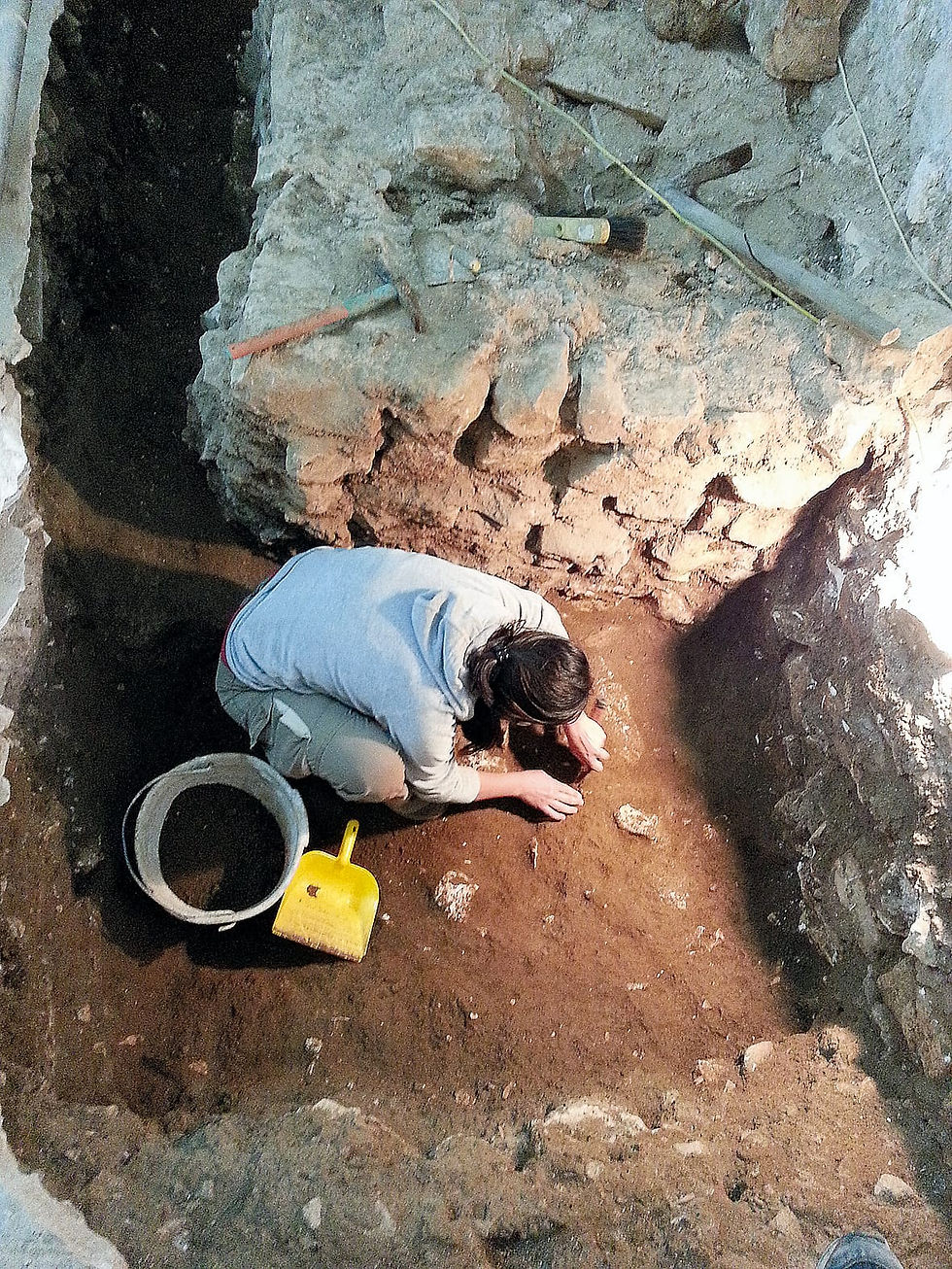
Nel 2004, durante lavori in via Tommaso Fiore, affiora una tomba con uno scheletro e un ricco corredo funerario composto da vasi integri, fibule in bronzo e ferro, elementi decorativi in ambra e pasta vitrea. Gli archeologi datano la sepoltura al IV secolo a.C. e ipotizzano che appartenesse a una giovane donna, confermando l’importanza del centro peuceta di Turi e la presenza di una comunità strutturata e socialmente articolata.
In 2004, during works in Via Tommaso Fiore, a tomb came to light containing a skeleton and a rich funerary assemblage consisting of intact vessels, bronze and iron fibulae, and decorative elements made of amber and glass paste. Archaeologists date the burial to the 4th century BC and suggest it belonged to a young woman, confirming both the importance of the Peucetian centre of Turi and the presence of a structured and socially articulated community.
One of the most significant discoveries, however, occurred in 1990 in Via Castellana, where the remains of an ancient Peucetian settlement emerged together with particularly important burials. Among these was a male tomb with weaponry, defined by scholars as the “warrior’s tomb”. For the first time in Turi, this discovery provided not only a funerary context but also a broader picture of the organisation of the settlement. As archaeologist Donato Labate points out, this find is fundamental because it allows us to read everyday life, social hierarchies and cultural relations within a community fully integrated into the circuits of the ancient Mediterranean world.
Among the most extraordinary finds linked to Peucetian Turi is the famous tomb discovered in 1932, known for the large figured krater attributed to the so-called Painter of Piamo, now preserved at the Metropolitan Archaeological Museum of Bari. Decorated with refined Dionysian scenes, the vessel evokes the world of the symposium and ritual, revealing the social prestige of the deceased and the high cultural level of the patronage. Through this artefact, Turi is placed within a historical and artistic dimension of Magna Graecia, bearing witness to a continuous dialogue between indigenous culture and Hellenic influences.

The layers of history do not end with antiquity. Over the centuries, the city transformed, fortified itself and reorganised its urban fabric. Excavations carried out in 2018 during repaving works in Piazza Chiesa brought to light sections of the medieval city walls near the ancient Porta Rossa, one of the main gateways to the historic town. The uncovered structures, older than previously thought, confirm the strategic importance of this area. Although initially documented and secured, the site was later left without any real valorisation, becoming a symbol of a heritage that resurfaces yet remains suspended, awaiting a vision capable of integrating it into the life of the city.
In 2010, near the old cemetery, four tombs dating between the 6th and 3rd centuries BC were identified. In 2014, during renovation works around the cloister of the municipal library, a fragment of the earliest Turi emerged, referable to an Iron Age hut village. In this case too, the excavation was completed and secured, but never equipped for public access.

Taken together, these discoveries clearly point to one conclusion: Turi possesses all the characteristics needed to be recognised as a dispersed archaeological city. This is strongly emphasised in the il paese supplement (issue no. 323, July–August 2024), which brings together finds, studies, maps and testimonies covering a very broad chronological span, from prehistory to the medieval period. Projects such as the Museum of Stone, the City Museum or the Museum of Thuria Peuceta, repeatedly mentioned in local cultural debate, remain unfinished ideas to this day, despite the solid scientific foundations on which they are based.

Telling the archaeological story of Turi today means restoring dignity to a deep and fragmented memory, transforming knowledge into collective awareness. It means recognising archaeology not as an obstacle to development, but as a resource capable of generating identity, culture and future. Because a city that knows how to read its roots does not remain imprisoned by the past, but finds in the past the tools to design what lies ahead.
Sources and credits
Texts and research drawn from and reworked from: Giovanni Lerede, il paese, no. 323, July–August 2024 Donato Labate, studies on the Peucetian settlement of Turi and the archaeology of the area Centro Studi di Storia e Cultura di Turi, journal Sulletracce
Photographs: Giovanni PalmisanoArchive of the Archaeological Superintendency of Apulia
Artefacts cited: Metropolitan Archaeological Museum of Bari


Comments